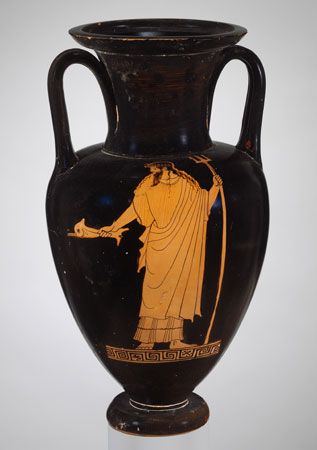
Poseidon's Ascent: From Swallowed Child to Sea Sovereign
The ancient Greek pantheon is rich with tales of immense power, dramatic conflicts, and divine lineage. Among the most formidable figures stands Poseidon, the mighty ruler of the seas, storms, and earthquakes. His journey to becoming one of the twelve Olympian gods is a saga marked by a desperate struggle for power against his own father, a cataclysmic war that reshaped the cosmos, and ultimately, the establishment of his vast underwater domain. This foundational narrative not only illuminates Poseidon's character but also sets the stage for the emergence of his influential offspring, including the iconic
Griechischer Meeresgott Sohn Poseidons, Triton.
Born into Peril: Kronos's Prophecy and Zeus's Intervention
Poseidon's life began under the shadow of a terrifying prophecy. His father, Kronos, the reigning Titan and a deity consumed by paranoia, had been warned that one of his own children would one day overthrow him. To defy this fate, Kronos resorted to a horrifying measure: he swallowed each of his offspring immediately after their birth. Poseidon, along with his siblings Hestia, Demeter, Hera, and Hades, met this grim fate.
However, Rhea, their mother, eventually devised a cunning plan to save her sixth child, Zeus. By substituting a stone wrapped in swaddling clothes for the infant Zeus, she ensured his survival. Zeus, once grown to adulthood, returned to exact vengeance and liberate his siblings. Through a clever ruse (often involving a potent emetic administered to Kronos), Zeus forced his father to regurgitate his swallowed children, who, being immortal, emerged fully grown and ready for battle. This pivotal moment marked the formation of the core Olympian pantheon, united in their desire to end their father's tyrannical reign.
The Titanomachy: A Clash of Cosmic Proportions
The liberation of his siblings was merely the prelude to an even greater conflict: the Titanomachy. This ten-year war pitted the youthful, ascendant Olympian gods against the elder, more established Titans for control of the cosmos. It was a struggle of unprecedented scale and ferocity, shaking the very foundations of the world. Initially, the battle was evenly matched, but the Olympians gained a decisive advantage through powerful alliances.
Crucial to their victory were the Hekatoncheires, three giants with a hundred hands and fifty heads each, and the Cyclopes, one-eyed giants renowned for their craftsmanship. These formidable allies, freed from Tartarus by Zeus, provided the Olympians with not only their immense strength but also their legendary weaponry. The Cyclopes forged Zeus his thunderbolt, Hades his helmet of invisibility, and for Poseidon, the magnificent trident – a symbol that would forever be his mark of power and authority. These divine weapons, imbued with incredible might, turned the tide of the war, enabling the Olympians to defeat and imprison the Titans in the darkest depths of Tartarus.
With the Titans vanquished, the victorious brothers divided the world among themselves by lot. Zeus claimed the vast expanse of the sky, Hades took dominion over the shadowy underworld, and Poseidon was granted the boundless, powerful realm of the sea. Thus, Poseidon officially became the *Griechischer Meeresgott*, his journey from a swallowed infant to a formidable deity of the oceans complete.
The Realm of Poseidon: Power, Passion, and Paternity
As the newly enthroned ruler of the seas, Poseidon quickly established his immense power and influence. His domain encompassed not only the churning waves and tranquil depths but also the earth itself, giving him the epithet "Earth-Shaker." He commanded storms, caused earthquakes, and his magnificent palace lay hidden beneath the ocean's surface, a realm of unparalleled beauty and mystery.
Amphitrite: His Queen and the Official Lineage
Despite his often tempestuous nature, Poseidon eventually took a queen: Amphitrite. She was a beautiful Nereid or Okeanid (a sea nymph), known for her grace and as a true mistress of the seas. Their union represented the official, legitimate lineage of the sea king. Together, Poseidon and Amphitrite had several notable children. Among them were Rhode and Benthesikyme, goddesses associated with various aspects of the sea. They also birthed the magnificent horse Areion, highlighting Poseidon's deep connection to horses, a creature so sacred to him that one of his epithets was "Hippios" (of horses).
However, perhaps their most celebrated offspring, and the one most relevant to our focus, was
Triton, the definitive Griechischer Meeresgott Sohn Poseidons. Triton inherited his father's domain and often served as his herald and messenger.
The Trident: Symbol of Unrivalled Authority
The trident, forged by the Cyclopes, was not merely a weapon; it was the ultimate emblem of Poseidon's dominion. With it, he could stir the oceans into a furious tempest, calm the wildest waves, cause earthquakes to shatter the land, and even summon sea monsters from the abyssal depths. This powerful three-pronged spear became synonymous with his image, instantly recognizable as the tool of the sea god. Its presence in art and literature across millennia underscores its enduring symbolic power as a representation of command over the aquatic world and the forces of nature.
Beyond Amphitrite: Poseidon's Diverse Progeny and Their Impact
Like his brother Zeus, Poseidon was known for his numerous romantic liaisons outside of his marriage to Amphitrite. These affairs, often with sea nymphs, mortals, and even other deities, led to a vast and diverse progeny, many of whom played significant roles in Greek mythology. This aspect of Poseidon's character showcases his raw power and unbridled passion, often resulting in children with extraordinary abilities or formidable challenges.
Notable Children from Other Unions
Among his most famous illegitimate offspring are:
* **Orion:** A giant and a skilled hunter, born from an affair with Euryale. His immense stature and prowess in hunting led to various myths surrounding his adventures and eventual placement among the stars as a constellation.
* **Polyphemus:** One of the most infamous Cyclopes, born to Poseidon and the nymph Thoosa. He is famously encountered by Odysseus in Homer's *Odyssey*, a brutal, man-eating giant whose blinding by the cunning hero brings Poseidon's wrath upon Odysseus's long journey home. This tale illustrates the formidable challenges faced by those who incur the sea god's displeasure.
* **Antaios:** A giant born from Poseidon's union with Gaia, the primordial goddess of the Earth. Antaios possessed almost unbeatable strength as long as he remained in contact with the ground. He challenged all passersby to wrestling matches, drawing his power from his mother. He was eventually defeated by Herakles, who lifted him into the air, depriving him of his strength.
These diverse children highlight the wide-ranging influence and often complex nature of Poseidon's relationships. From fearsome giants to legendary heroes,
Poseidon's divine children populated many of the most captivating tales of ancient Greece, reflecting various facets of his own powerful and often unpredictable character.
The Lasting Legacy of Triton
While Poseidon's other children often represent strength, savagery, or earthly connections, Triton stands out as the direct heir to his aquatic kingdom. He is unequivocally the Griechischer Meeresgott Sohn Poseidons, embodying the essence of the sea in his very being. Often depicted as a merman, with the upper body of a man and the lower body of a fish, Triton is most famously associated with his conch shell, which he uses as a trumpet to either calm or rouse the waves, echoing his father's command over the ocean. He is both a faithful servant and a powerful entity in his own right, assisting sailors and guiding his father's chariots.
Triton's presence in mythology solidifies his role as the archetypal sea-god-son, a direct continuation of Poseidon's dominion. His name, with its concise 6 letters, perfectly fits the description of "Griechischer Meeresgott Sohn Poseidons" in ancient riddles and crosswords, testifying to his clear and established identity within the pantheon.
Triton: The Conch-Wielding Heir to the Sea King
As the most recognized and influential offspring of Poseidon and Amphitrite, Triton holds a unique position in Greek mythology. He is the personification of the waves, a demigod who blends the human form with the majesty of marine life, signifying his deep connection to the aquatic world.
The Specifics of Triton: Appearance and Role
Triton is typically depicted with the upper body of a man and the tail of a fish, sometimes with green hair and a beard, reflecting the sea's wild beauty. His most distinctive attribute is his **conch shell trumpet**. With this powerful instrument, he could produce sounds that ranged from a gentle whisper, calming the stormiest seas, to a thunderous roar capable of terrifying giants. Sailors often believed they heard Triton's calls across the water, either as a warning or a sign of divine presence. He frequently accompanied his father, riding on chariots pulled by sea-horses or serving as a herald, announcing Poseidon's arrival with a blast of his shell. He also played a role in assisting sailors and guiding ships, often appearing to heroes in times of need.
Triton's Name and Significance
The name TRITON, with its six letters, is the definitive answer to the query "Griechischer Meeresgott Sohn Poseidons." This simple fact underscores his unambiguous identity and importance within the mythological framework. He isn't merely one of many children; he is *the* son who shares his father's domain and often his iconography. His existence provides a clear lineage and a tangible representation of Poseidon's continued influence over the seas through his legitimate heir.
Cultural Relevance
Triton's imagery has transcended ancient mythology, appearing consistently in art, literature, and even architecture throughout history. From Roman mosaics to Renaissance fountains and modern fantasy, the figure of the merman blowing a conch shell is universally understood as a symbol of the sea's power and mystery. He represents the voice of the ocean, the one who can command its moods, and a benevolent, albeit powerful, presence within its depths. His enduring presence solidifies his status not just as a mythological character, but as an iconic cultural figure directly linked to the might of Poseidon.
Conclusion
Poseidon's narrative is a thrilling testament to power, survival, and dominion. From being swallowed by Kronos to wielding the mighty trident in the Titanomachy, his journey to becoming the undisputed ruler of the seas is a cornerstone of Greek mythology. His vast realm is a reflection of his own tempestuous yet powerful nature, and his diverse lineage, ranging from formidable giants to the graceful Triton, populates many of the most captivating tales. Above all, it is Triton, the conch-blowing messenger and merman, who truly embodies the legacy of the sea king, standing as the definitive
Griechischer Meeresgott Sohn Poseidons. His story, alongside his father's, continues to captivate and inspire, reminding us of the enduring allure of the ancient Greek gods and their profound connection to the natural world.